
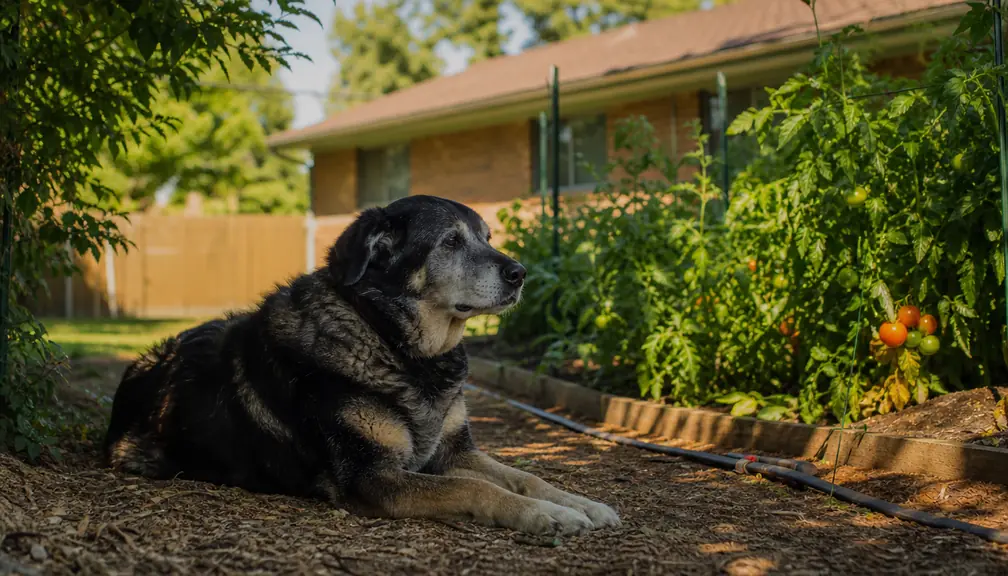
Last September I stood in my kitchen at six in the morning and watched my dog think about standing up. Hazel is a ten year old Golden Retriever, sixty four pounds, and she had never made me wait like that before. A few days later she stopped at the bottom of the two brick steps off the back porch and took her time going up, the way you take your time on a staircase when your knees are complaining. I am not a veterinarian. I am sixty one, retired from a church office, and I read every label in this house twice. But I know what slow looks like in a dog I have had since she was eight weeks old.
That week I made a list, read too much on the internet, and then called Dr. Patel at our clinic in Aiken. She told me to bring her the label before I bought anything, and she said what she always says, that a supplement is not a fix and that keeping Hazel's weight down and keeping her moving matter more than anything that comes in a bag. The first label I set on her desk was Nutramax Dasuquin, the soft chews for large dogs. That was October 2025, and it was the first joint supplement Hazel had ever had. What follows is the order I did things in, including the parts I would do differently.
The beef soft chew Hazel gets at breakfast, if your vet says yes
Dasuquin soft chews for large dogs from Nutramax. The label lists glucosamine hydrochloride, MSM and sodium chondroitin, plus ASU. Ask your veterinarian before the first one.
Amazon Check Today's Price on Amazon →Step 1: Ask Your Vet Before You Open the Bag
I wrote three questions on the back of an envelope and took them to our appointment. Is a joint supplement worth trying at all for a dog this age. Is there anything in this particular one that would not sit right with Hazel. And how long do I give it before I decide it is not working. Dr. Patel answered all three. What she said about the first one is the part I want you to hear, and it is the reason I am careful in this article: a chew is not a treatment. Nobody at that clinic was going to tell me it would turn my ten year old dog into a seven year old dog, and nobody should tell you that either.
She also asked whether Hazel takes any medication. She does not. If your dog does, that is the conversation to have before the bag is open rather than after, because some things do interact, and I am not the person who can tell you which ones. Neither is a review on a retail page, mine included. Your vet knows your dog's history and I do not.
The third question is the one I got wrong in my own head. I wanted a number of weeks. Dr. Patel would not give me one, and in hindsight I am glad, because if she had said six weeks and I had seen nothing at six weeks, I would have quit something that needed longer. Ask your vet how long to give it, then listen to that answer instead of the one you were hoping for on the drive over.
Step 2: Read the Label Like You Are Going to Be Quizzed on It
The actives are printed on the back of the bag, and I copied them into my notebook so I could look them up at my own kitchen table instead of standing in an aisle with my reading glasses in my hand. Glucosamine hydrochloride 99 percent at 900 mg. Methylsulfonylmethane, which everybody shortens to MSM, at 800 mg. Sodium chondroitin. And the one I had not run into before, avocado/soybean unsaponifiables, ASU for short. The Nutramax listing says the ASU is what takes Dasuquin past a plain glucosamine chew, and I will tell you plainly that the brand is the one saying that, not me.
The serving is printed by weight. I give Hazel what the label calls for at her weight and I do not improvise, and I am not going to write a dose for your dog in this article. That number belongs on your bag and it belongs in a conversation with your vet, who knows what else your dog is taking and how much she actually weighs that day. If you have a scale at home, use it. My bathroom scale and a sixty four pound dog is not a precise instrument, so we use the clinic's.
One practical thing about the bag. It is 84 chews, beef flavor, soft, and it smells like a bouillon cube, which is why Hazel takes it out of my hand without a discussion. Because she is a large dog, the bag goes faster than I expected that first month. That is not a complaint, it is a planning note, so the second bag is not a surprise.
Step 3: Put the Chew Where Her Day Already Has a Slot
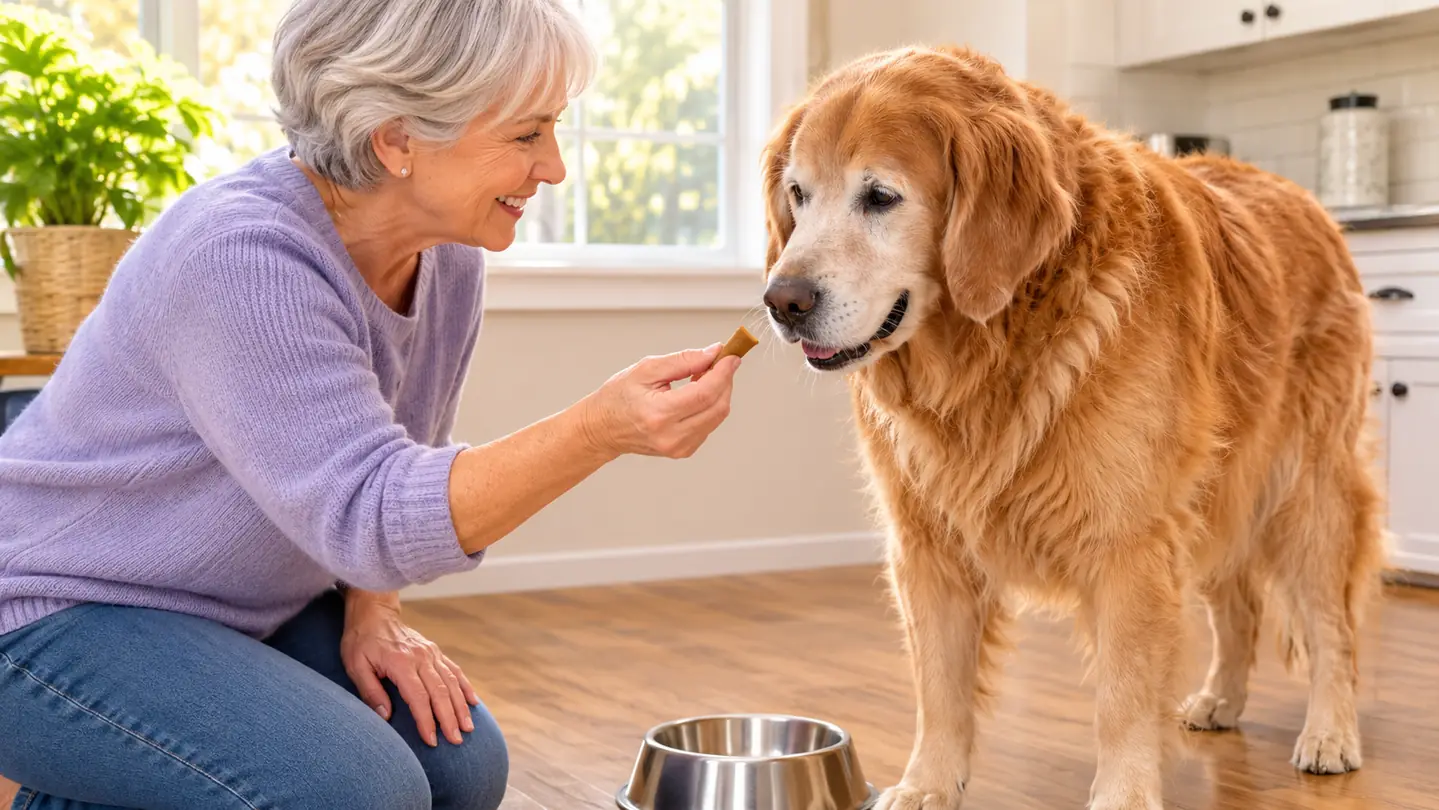
Hazel eats breakfast in the kitchen around six thirty, on the laminate floor, and that is where the chew goes. Not in her bowl, not wrapped in anything, just from my hand before the kibble comes out. It takes four seconds and it does not require me to remember a second event later in the day. That was deliberate. I have started and abandoned more routines than I can count because they needed their own appointment, and a dog does not care about your calendar.
The order in our house is breakfast, the chew, out to the backyard, then the slow walk around the block while it is still cool. She gets her fish oil over the kibble and a mussel bite in the evening, and I will say here what I say everywhere: with three things going into one dog, I cannot prove which one did what. What I can tell you is that the chew is the easiest of the three to hand over, because she thinks it is a cookie and she has never once turned her nose up at it.
If your dog is a gulper, watch the first one. Hazel is not, but I have had dogs who were, and a soft chew is exactly the shape that goes down whole. If your dog inhales food, ask your vet whether to break it up, and stay in the room while she eats it. That is not a supplement question, that is just good sense around a dog who eats like a shop vacuum.
Step 4: Give It Weeks, Not Days, and Write Down What You See
I keep a small notebook in the kitchen drawer. Nothing fancy, just dates and short lines. October 12, took it fine. November 2, up off the floor without the long pause. November 20, cold morning, slow at the porch steps. It sounds like a chore and it takes ten seconds, but memory is a liar, especially when you are hoping for something. Without the notebook I would have told you she was better in a week, and I would have been wrong.
For Hazel, the thing I noticed came somewhere around seven or eight weeks in. She got up off the kitchen floor one morning without that pause, the one I had been bracing for since September. I cannot swear the chews did it. I can swear that is when it happened, and I can swear nothing else in our routine changed that month. That is the whole of my evidence, and I am not going to dress it up into more than it is.
Your dog is not Hazel. Do not read my seven or eight weeks as a schedule, and do not decide on day nine that the bag was a waste. Ask your vet when to check back in. Dr. Patel had us in for a weight check and a look at how she was moving, which is a better use of an appointment than me squinting at her on the porch trying to remember last Tuesday.
Step 5: Store the Bag So the Chews Stay Chews
Soft chews dry out. I learned that with the first bag, which sat open on the counter for a week in the South Carolina humidity and turned the last handful into something I would not have offered her. Now I press the air out, seal it, and keep it in a cool cabinet. Not the refrigerator, and never the car. Dry hands, sealed bag, cool shelf. That is the whole system and it takes less time than reading this paragraph.
I also do not dump the bag into a pretty jar. The dates and the lot information are on the bag, and if I ever needed to look at them I would want the bag. It lives on the second shelf behind the baking powder, which is a sentence that tells you a good deal about my kitchen.
Check the date when the bag arrives, the way you would with anything in your pantry. And plan the reorder before you are down to the last two chews, because a routine is only a routine if it does not have a gap in it where nobody remembered to order.
What Else Helps
The chew is one part of a week and I would be lying if I said it was the biggest part. The biggest part is that Dr. Patel weighs Hazel at every visit and tells me straight when the number has crept up, because extra weight on an older dog is extra work for every step she takes. The second biggest part is the walks. Twenty slow minutes around the block after breakfast while the pavement is still cool, and a shorter one in the evening. Not fast, not far, just most days.
The floor matters more than I expected. Our kitchen, hallway and living room are laminate, and a dog who is careful on her feet gets more careful on a slick floor. Before I bought anything for her feet I put a runner rug down the hallway, and that alone changed how she moved through the house. Where she sleeps mattered too, because the corner of the living room is where she spends her late afternoons and her nights, and a thin old pillow is not much of a landing pad for sixty four pounds.
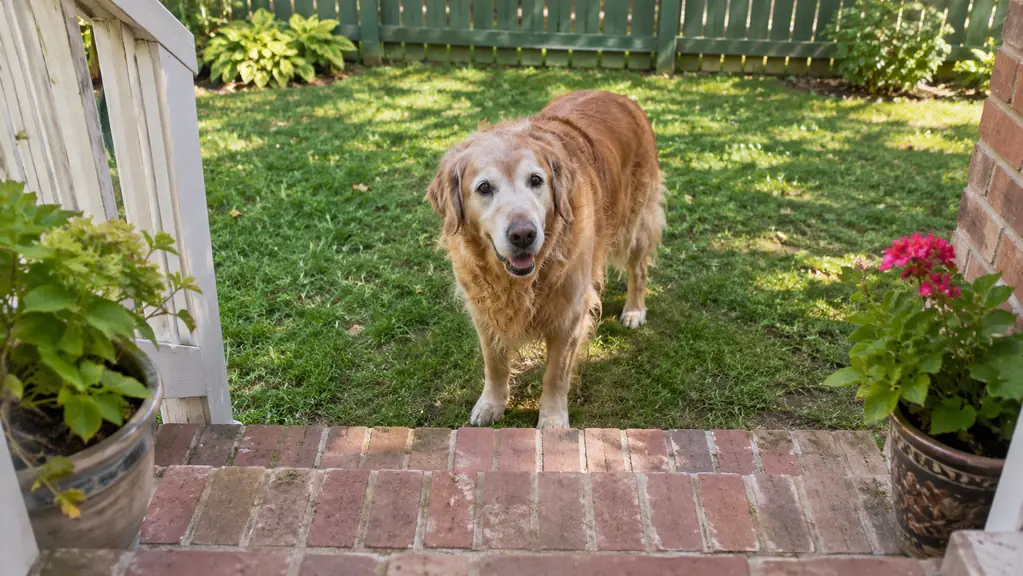
And I keep the two brick steps in mind. Two steps, that is all, but I watch them. On cold damp mornings she is slower on them than on a dry afternoon, and I let her set the pace. If your dog is hesitating at a step, that is a thing to mention at your next appointment rather than something to push through on a Tuesday.
Seven or eight weeks in, she got up off the kitchen floor without the long pause. I cannot swear the chews did it, and I have stopped needing to know.
What Dasuquin Did Not Do
It did not give me my young dog back. Hazel is still ten. She is still slower than she was two years ago, she is still careful on a damp morning, and she still takes her time at the bottom of those two steps. Anyone who tells you a chew changes that is selling something, and I have no interest in being that person. The Nutramax listing says more veterinarians recommend Dasuquin than any other brand, which is the brand talking about itself, not a thing I can verify from my kitchen.
It also costs more than the plain glucosamine chews on the shelf at the feed store, and it took weeks before I had anything worth writing in my notebook. Those are the two honest drawbacks. If either one is a dealbreaker for your budget or your patience, plain chews and a conversation with your vet are a perfectly respectable path, and I have compared the Dasuquin and Cosequin labels side by side in a store more than once without ever talking myself into one being wrong. I bought this one because of what the label lists, and I kept buying it because of what I saw. That is as far as my case goes. Ask Dr. Patel, or your own vet, before you buy either.
If your vet gives the go-ahead, this is the bag I keep on the second shelf
Dasuquin soft chews for large dogs from Nutramax. Beef flavor, 84 count, with glucosamine hydrochloride, MSM, sodium chondroitin and ASU on the label. Your vet sets the serving for your dog, not me.
Amazon Check Today's Price on Amazon →