
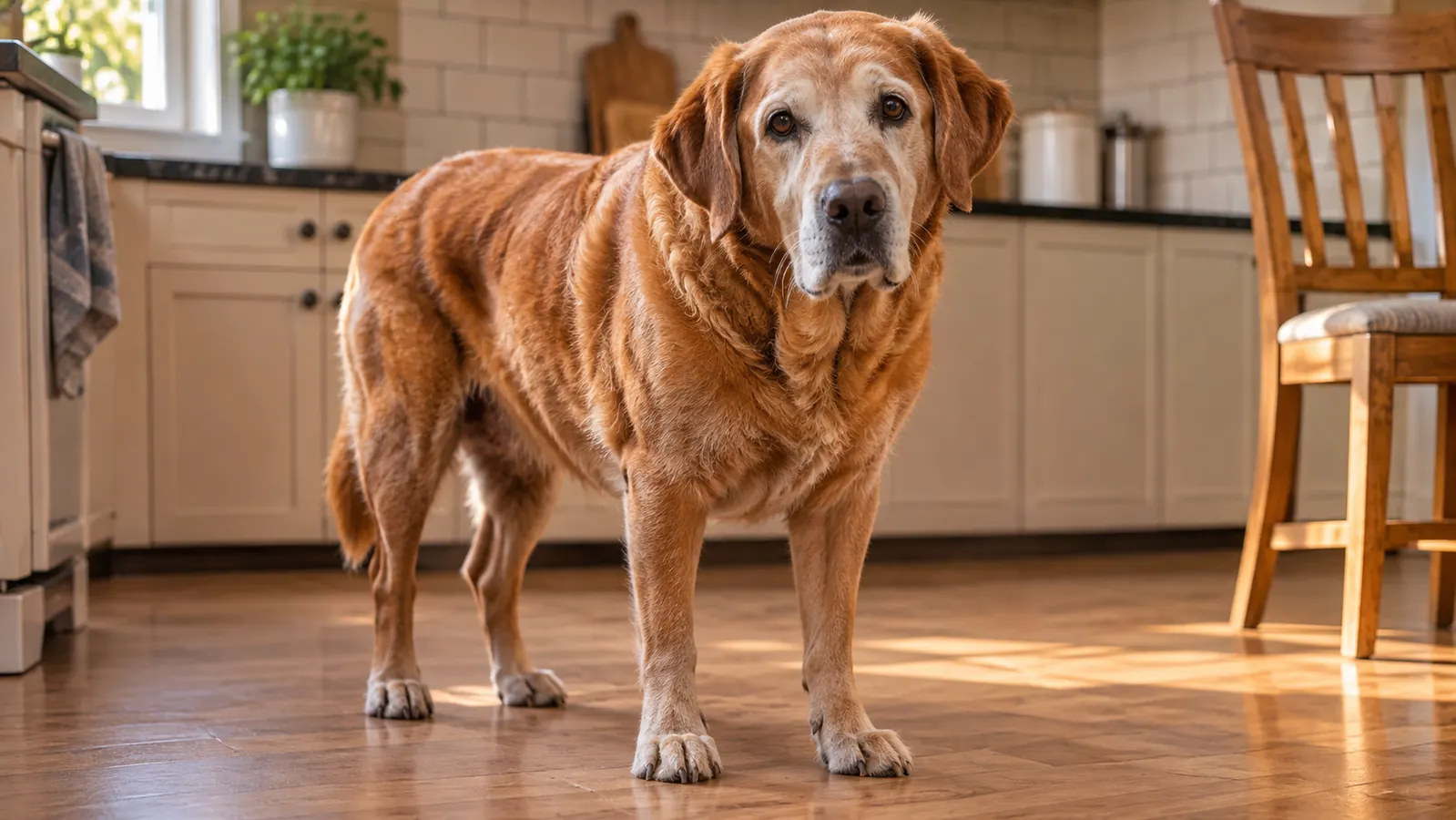
Hazel turned ten in April, and the laminate floor in my kitchen has never been her friend. She is a Golden Retriever, sixty-four pounds, and last fall I started noticing her back feet slide out from under her when she turned too fast toward the oven. Not a fall. A small skid, a scramble, then a pause while she got her footing back. If you have an older dog on a hard floor you have probably watched the same thing and felt your stomach drop. I am not a veterinarian or a trainer. I am sixty-one, retired, and I live in Aiken, South Carolina, and I bought a set of DOK TigerToes non-slip dog socks myself, on Amazon, after I asked Dr. Patel about them. This is how I measured, how I fit them, and what I would do differently.
The part nobody tells you is that the socks are not the hard part. The measuring is the hard part. Order the wrong size and you get a sock that either slides off by the second step or squeezes until your dog walks like she is on hot pavement, and then the whole idea goes in a drawer. I nearly did that. What saved me was a plain wooden ruler out of Dale's toolbox and five minutes on the kitchen floor before I clicked anything. So before we get to putting them on, we are going to get the number right.
One number decides whether these socks work: the paw width
The X-Large is listed at 2.9 to 3.4 inches across. Measure your dog's paw flat on the floor first, then check the listing against your number.
Amazon See the DOK TigerToes sizing on Amazon →Step 1: Measure the Paw While Your Dog Is Standing
Have your dog stand on a hard, flat surface. Not a rug, not carpet, not the couch. Standing matters because a paw spreads out under weight, and a paw measured while the dog is lying down will read narrow, so you order a size too small and spend the next two weeks watching a sock rotate off a heel. I did this in the kitchen with Hazel standing still and a smear of peanut butter on a plate in front of her, which is the only trick I know for keeping a Golden Retriever in one spot for thirty seconds.
Lay the ruler flat across the widest part of the paw, usually just behind the toes, and read it straight down. Do not measure around the paw like a bracelet. You want one number: the width in inches. Do the front paws first, and do both of them, because a dog can be a little wider on one side. Hazel's front paw came out at about 3.1 inches. Write the number on the back of an envelope and put it on the refrigerator. You will want it again, and you will not want to remeasure a dog who has decided she is finished with the whole project.
If your dog will stand for it, measure the back paws too, because they are not always the same as the front. Hazel's back paws came out a hair narrower than her fronts, and since the set is one size for all four feet, I wrote both numbers down and checked that the size on the listing covered the wider of the two. That is the number that matters when you order. It also gives you a baseline. If a front paw measures 3.1 this year and 3.2 next spring, you will know it, and you will not be guessing when it comes time to buy a second set.
If your number lands right on the line between two sizes, go with the larger one and use the closure to take up the slack. The material is cotton and nylon and it stretches, so there is a little room to work with, but there is no way to add material to a sock that is too small. And if you are measuring a dog who does not like her feet handled, do one paw a day and stop when she has had enough. There is no prize for finishing in one sitting.
Step 2: Match Your Number to the Size on the Listing
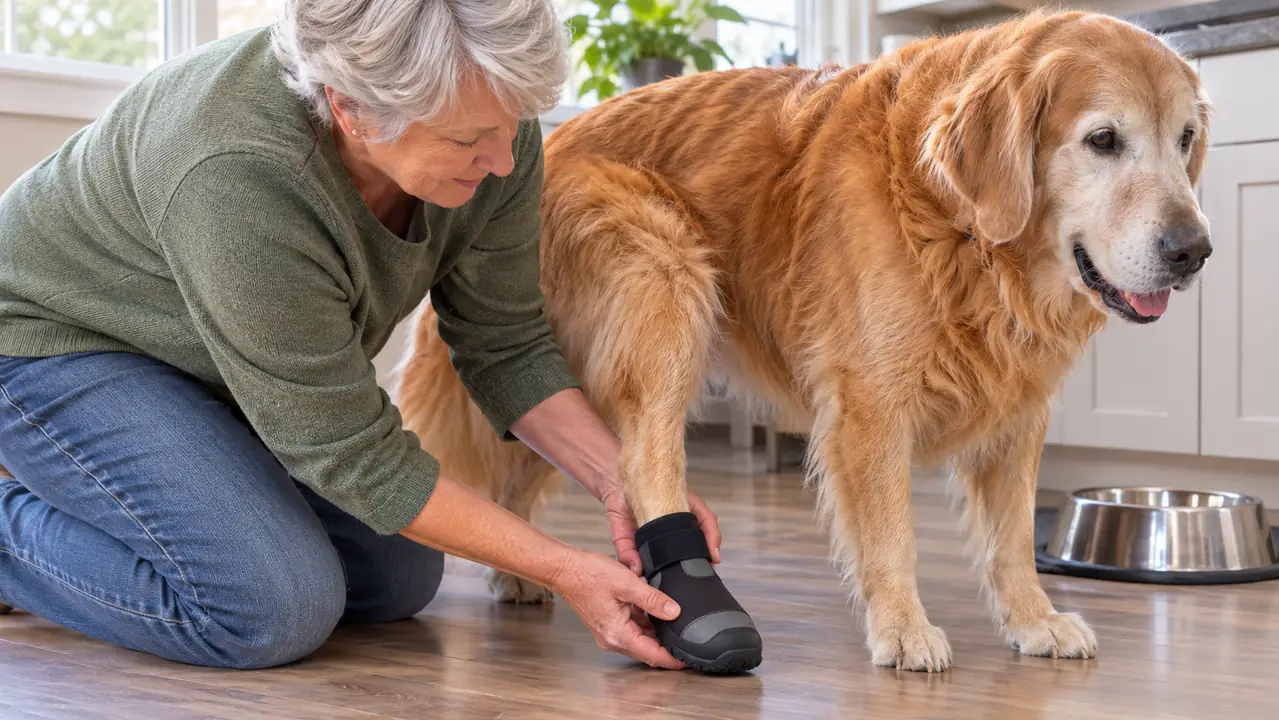
The DOK listing for the X-Large gives a paw width of 2.9 to 3.4 inches, and that is the only measurement I cared about. Hazel at 3.1 sat right in the middle of it, which is where you want to be. The set comes with four socks, one for each paw, and the closure is hook and loop with a pull-on fit. The listing also gives the product dimensions as 3.5 by 3.25 by 0.25 inches and the item weight as 4.7 ounces, which tells you these are thin and light, not boots.
Read the care instructions before the first wear, not after the first wash. This set is machine washable, and knowing that up front saved me from hand scrubbing four socks on a Sunday night. While you have the bag in your hands, read the note about the grip, because that is the part that made me buy them. The listing says the grip is made to keep working even when the sock twists around on the paw. Keep that in mind, because it comes up again in step five.
Look at the recommended uses on the listing while you are there. It names dog mobility and paw protection, and it also names paw licking, which is the other reason people buy these. I bought mine for the floor and nothing else. If your dog is worrying at a paw, a sock can keep her off it for an afternoon, but it will not tell you why she started, and that is a question for your vet. A cover is not an answer.
One more thing before the bag comes open. I asked Dr. Patel about these before I ordered, and I would tell anyone else to do the same, especially if your dog has a diagnosed condition, takes medication, or has a paw that is already sore or bandaged. A sock is not a treatment for anything. It is a piece of fabric between a paw and a floor. If your dog's slipping is new, or getting worse quickly, that is a conversation for your vet, not a shopping cart.
Step 3: Put the First Sock On While Your Dog Is Calm
Put the first sock on when your dog is standing and calm, not when she is excited about a walk. The pull-on opening stretches over the paw and then the hook and loop strap closes across the top. Slide it on so the grip side faces down and the strap sits above the toes, not over them. Snug, not tight. I check by trying to slide one finger under the strap. If I cannot, it is too tight and I loosen it a notch.
Do one sock, then stop and let her walk around the kitchen. The first morning Hazel high-stepped around like the floor had turned to ice, lifting each foot higher than it needed to go, and I stood there thinking I had wasted the money. By the third day she ignored them completely. That is not a brag about the socks, it is just how long it took her to stop noticing them. Give your dog those same few days before you decide anything.
The back paws are harder than the front, for the obvious reason that you are reaching around behind a dog who would rather be doing something else. I do the back two while Hazel is standing at her bowl with breakfast in it. If your dog snaps or pulls a foot away, stop and try again later. There is no sock in the world worth a bite, and a dog who is already stiff should not be asked to hold an awkward position while you fuss with a strap.
Step 4: Set a Wear Schedule and Check Paws Every Night
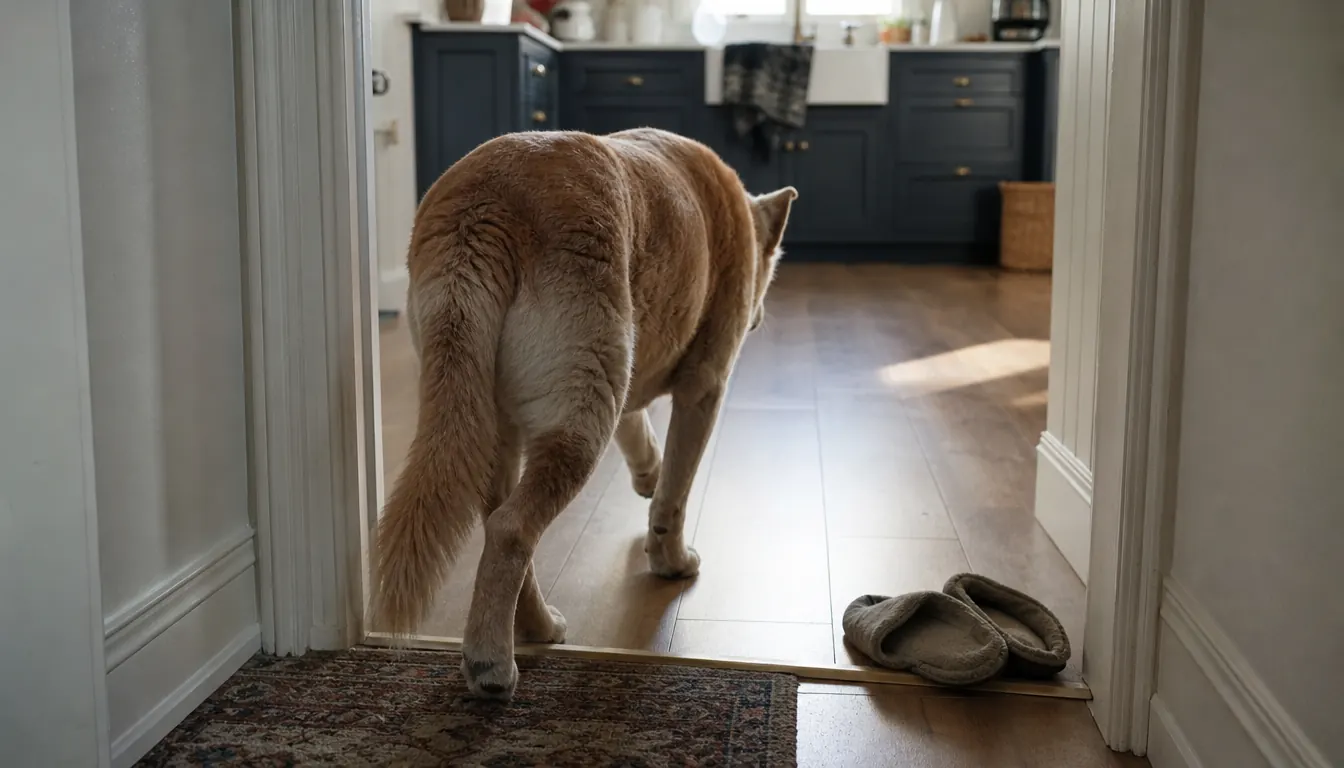
In this house the socks go on after breakfast and come off at bedtime. Overnight they come off, every night, no exceptions. A dog's paws need to breathe, and a sock that stays damp against the skin is a problem waiting to happen. That is my rule, not something from the label, and I would make the same one for anyone.
Every night when I take them off I look at all four paws. I am checking for red marks, rub spots, a chewed seam, or anything that looks damp or smells wrong. If I find something, the socks stay off the next day. In twelve months I have found one small rub mark, at the back of one heel, and I gave that paw two days off. If you see a sore, an open spot, or a paw that is warm and swollen, that is a call to your vet and not something to cover with a sock and hope about.
Watch how your dog behaves in them too. A dog who stands still and refuses to move is telling you something. So is a dog who chews at the strap. Hazel went through the high-stepping stage and settled, but if she had not settled within a week I would have taken that as a no and moved on. And these are indoor socks. She has never worn them out to the garden or around the block, because wet grass and pavement would undo everything the wash is for.
Step 5: Handle the Twist and Keep the Grip Through the Wash
Here is the honest part. On Hazel the two back socks twist. Not the fronts, just the backs, and by midafternoon they are usually turned about a quarter of the way around and the strap has worked a little loose. I re-seat them once or twice a day, usually when she gets up from her nap, and that is the whole fix. It takes ten seconds. But you should know it happens before you buy, because a person expecting four socks to stay perfectly square all day will be disappointed.
The twist has not cost me the grip. The listing says the grip keeps working even when the sock turns, and on my kitchen floor I would say that is accurate. She still gets traction on the turned sock. That is the reason I stopped looking at other options after the first month. If the grip had quit every time a back sock rotated, I would have sent them back.
They get washed on Sundays, all four at once, in the machine, and I let them air dry. Before they go back on I look at the sole. When the grip starts to look smooth or shiny in the middle, that sock is done for the kitchen floor and becomes a sock for a dog who is only lying around. Twelve months in, the fronts are still in good shape and one of the backs is getting thin. I would rather tell you that than pretend a set lasts forever.
What Else Helps
The socks were not the only change in this house, and I would be lying if I gave them all the credit. The runner rug in the hallway was the first thing I did and it still does most of the work on that stretch of floor. I keep Hazel's nails short, because a long nail lifts the paw and makes a skid more likely. I put a plain non-slip mat at the bottom of the two porch steps, since that is the only set of steps she uses. And I cleared the kitchen path so she is not threading between the trash can and the island every time she comes in for water.
Cold, damp mornings are her stiffest, and that has nothing to do with the floor. On those mornings I let her set the pace on the walk around the block and I do not rush her. Late in the day she likes to lie in the shade by the tomato beds while I weed, and I have stopped calling her in just because I think she has been out there long enough. An older dog knows when she wants to get up and when she wants to stay down, and it took me a while to learn to let her answer that herself.
None of that is expensive or clever. It is just the stuff you do when you finally admit your dog is older. I also had Dr. Patel look at her at her regular visit and asked whether the stiffness I was seeing needed anything more than what we were already doing, and that is a conversation worth having on its own before you spend money on anything. Hazel still takes her usual chew with breakfast and the oil over her kibble, and I have always said plainly that with three things in her bowl I cannot prove which one did what. The socks solved one small problem, the slippery floor, and left the rest of it alone.
The listing says the grip keeps working when a sock twists. On a Tuesday afternoon in my kitchen, with both back socks half turned around, that turned out to be true.
Start with the paw width, then let your dog tell you the rest
The DOK TigerToes X-Large is listed at 2.9 to 3.4 inches across and comes as a set of four. Measure first, ask your vet about anything that looks sore, and give your dog a few days to stop high-stepping.
Amazon See the X-Large set on Amazon →