

If you have two bags in your hands and about thirty seconds before your dog starts pulling toward the door, here is the short answer. Zesty Paws Mussel Mobility Bites are a soft chew built around New Zealand green-lipped mussel, and the listing says that mussel naturally carries glucosamine and chondroitin along with omega-3 fatty acids. A plain glucosamine chew is one named ingredient and a number on the panel. That is the whole difference in a sentence: one brings several things at once from a whole-food source, the other is a single measured ingredient. Neither one is medicine and neither one comes with a promise attached.
I am not a veterinarian and I am not going to write like one. I am sixty-one, I live in Aiken, South Carolina, and I have a ten-year-old Golden Retriever named Hazel who weighs sixty-four pounds. She turned ten in April. I have had her since she was eight weeks old, and the morning that started all of this was in September 2025. She took a long time getting up off the kitchen floor, and then she stood at the bottom of the two brick steps down to the backyard and did not go up right away. She had never done that. I read labels for a living once, in a church office, keeping track of who was allergic to what at every covered dish supper, and old habits are hard to put down. Since May, Hazel has been on the Zesty Paws bites, given in the evening after our short walk, and I asked Dr. Patel before I opened the tub. I have never owned a plain glucosamine chew. What I can do here is read both labels the way I read the back of a cake box, out loud, with my glasses on, and tell you what each one actually says.
| Zesty Paws Mussel Mobility Bites | A Plain Glucosamine Chew | |
|---|---|---|
| What the panel lists | Green-lipped mussel, which the listing says naturally carries glucosamine and chondroitin plus omega-3s, alongside benefit lines for joint, muscle and antioxidant support | Glucosamine, and depending on the bag a second name like chondroitin or MSM. One or two lines, nothing else |
| Knowing the amount you are giving | The mussel is a whole food, so the panel does not spell out how much glucosamine sits in each bite | Glucosamine is a named ingredient, so the amount per chew is printed on the bag for you to read |
| How much label reading it takes | A longer listing, and an active ingredient field that says chamomile, which is not what I expected to find there | One line to read and one number to hold in your head |
| Getting a ten-year-old dog to take it | Hazel takes hers like a cookie and looks for it after the walk | Varies by dog and by bag. Palatability is the one thing you cannot read on a panel |
| Sitting alongside a glucosamine chew already in the routine | A different source, so it does not read as the same molecule listed twice | Two glucosamine products in one day is a question for your vet, not a question for a label |
| Best for | An older dog already on a glucosamine chew whose owner wants a second, different source in the rotation | A dog just starting out, or an owner who wants exactly one measured ingredient and nothing to cross-check |
Where Zesty Paws Mussel Mobility Bites Wins
The first thing the Zesty Paws listing does that a plain glucosamine bag does not is bring more than one thing at a time from a single ingredient. The mussel itself is described as naturally carrying glucosamine and chondroitin, plus omega-3 fatty acids, and the product benefit lines name joint health, muscle health, antioxidant support and nutritional support. On a plain chew you are buying glucosamine, and if you want the rest you buy it separately or you buy a combination chew with four names in it. Here the mussel does the carrying.
The second thing, and the one that matters most in my kitchen, is that it does not read as the same molecule twice. Hazel has been on a glucosamine and chondroitin chew at breakfast since October, and I am careful about stacking the identical thing on top of the identical thing without asking. A whole-food mussel source is a different entry on the page. That is a label observation, not a medical opinion. I asked Dr. Patel, and I would want you to ask yours.
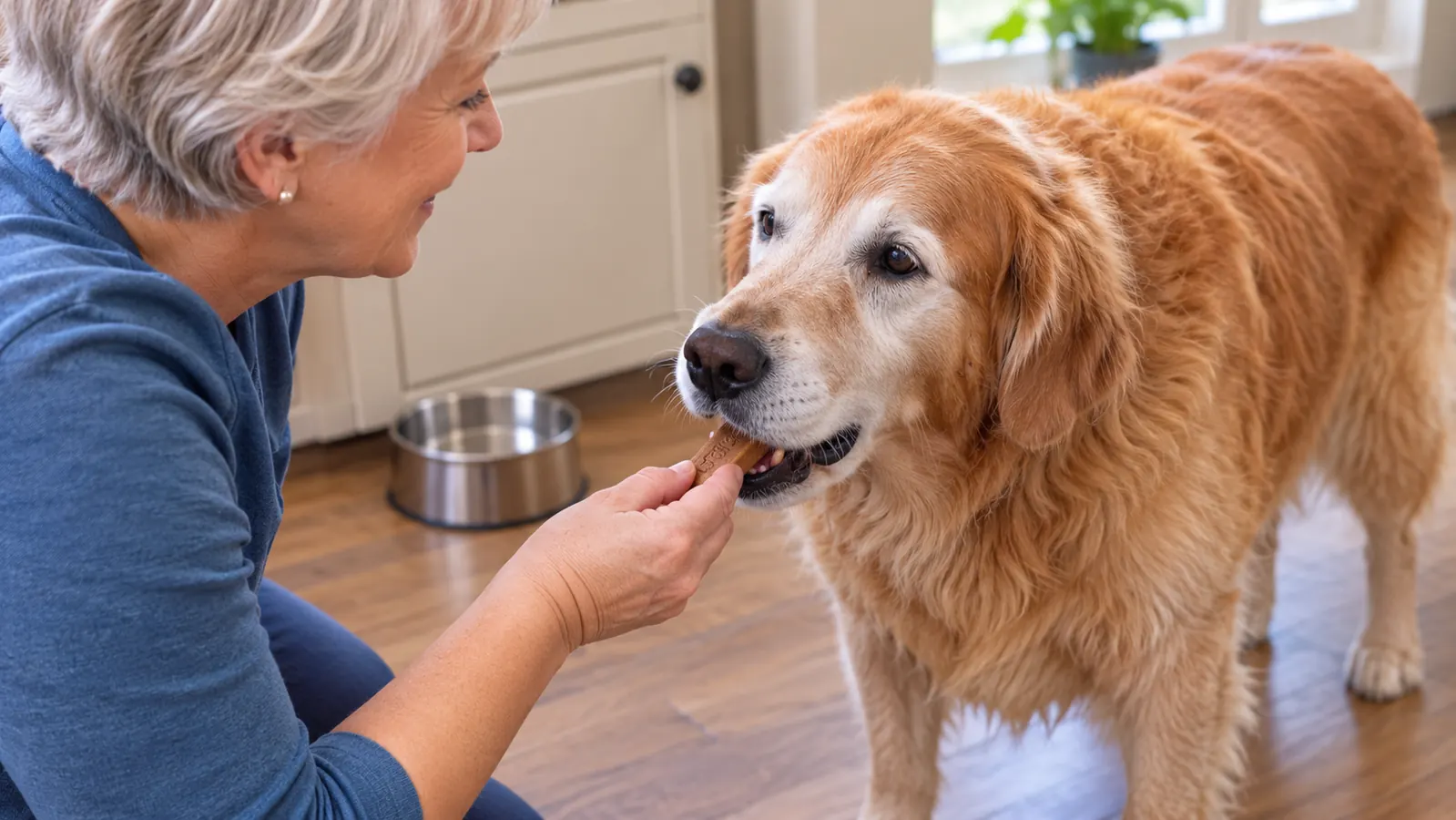
There is a practical side too. Ninety soft chews come in a 7.9 ounce tub, the bites are small, and Hazel treats hers like a cookie after the evening walk. A dog that turns her nose up at a supplement is a dog who is not getting it, and that problem solves itself here. The tub itself is small, about 3.66 by 3.58 by 3.23 inches per the listing, so it sits on the counter beside the bread box instead of in a cabinet where I would forget it. That sounds like a small thing. It is not. The fish oil lives in a cool cabinet because the bottle says so, and I have to think about it every morning. The tub I just see. At a sixty-four pound serving I go through it faster than I would like, so I keep a note in my purse and order the next one when I am down to the last several, not the last two. The listing also notes the mussels are cold processed and sourced from New Zealand, which is the kind of detail I like to see spelled out rather than implied.
Where a Plain Glucosamine Chew Wins
Here is where I have to be fair, because a plain glucosamine chew does something these bites cannot. It tells you the amount. Glucosamine is a named ingredient, so the milligrams per chew are printed on the bag in plain numbers, and you can write that number on a sticky note and hand it to your vet. With a whole-food mussel, the panel lists the mussel. It does not break the mussel down into a glucosamine figure per bite, because it cannot. If knowing exactly what you are giving, in numbers, is what lets you sleep at night, the plain chew is the honest answer. I do keep a sticky note. Mine has the name of the breakfast chew and a line telling me one chew with breakfast, because Dr. Patel asked me to write it down and stick it inside the cabinet door where I would see it. If that note had a milligram figure on it, I would feel better about it, and I will not pretend otherwise.
The other advantage is simplicity. One ingredient, one line, one number. You are not standing in the kitchen at six in the morning holding a tub in one hand and a bag in the other, trying to remember which one you gave yesterday and whether it overlaps with the other two things in the bowl. A plain chew is easier to hold in your head, easier to explain to a vet, and easier to keep straight if your dog is on other things. When my husband Dale feeds her on a Saturday so I can sleep in, I can tell him over the phone in one sentence what goes in the bowl. That is not nothing.
I will also say this plainly, because a comparison that gives one side every row is not a comparison. If your dog has never taken a joint supplement and you want to start with the simplest, most measured thing available, a plain glucosamine chew is a sensible and unglamorous place to begin, and it is a conversation to have with your vet rather than a decision to make in an aisle. I say that as someone who bought the mussel bites. There is a version of this where I hand you the tub and tell you it changed my dog overnight. I am not going to do that, because it would not be true, and because the plain bag has a real advantage I just spent two paragraphs describing.
The One I Actually Hand Her After the Walk
Hazel gets her Zesty Paws bite in the evening, after the short walk, and she takes it like a cookie. If that is the routine you are trying to build, this is the tub on my counter. Ask your vet before you start, the same as I did.
Amazon Check Today's Price on Amazon →What Six Months With the Bites Actually Looked Like
I want to be careful here, because this is where pet writing usually goes sideways. Hazel is ten. She is slower than she was at seven, and she is stiff on cold damp mornings no matter what is in her bowl. Since May she has had one Zesty Paws bite in the evening, on top of the glucosamine chew at breakfast and the fish oil pumped over her kibble. I noticed what I noticed, and I cannot prove which of the three did what. I have said that in every note I have written about her and I am saying it again.
What I can describe is the shape of the routine. The bites are small and she wolfs them, so there is no coaxing, no peanut butter, no bargaining at the counter. That alone makes them easy to keep up with, and keeping up with something for six months is worth more than a perfect plan you abandon in a week. I know, because I have abandoned a few. There was a powder I mixed into her food one winter, years back, that she picked around and left in the bowl, and I gave up on it by the second week. The bites do not require a decision. They go in my jacket pocket before the walk and they are gone by the time we are back up the two steps. The tub does not last long at a sixty-four pound serving, so I have learned to reorder before I am down to the last handful rather than after.
The other honest note is about what I cannot tell you. I cannot tell you these bites did anything the breakfast chew and the oil are not already doing. I cannot give you a timeline, and I will not, because your dog is not my dog and mine did not follow a script. What I can tell you is that I kept buying them, that she takes them without a fuss, and that the label is one I am comfortable reading. I keep a small notebook in the kitchen drawer with the date I opened each tub and where the last one came from, and when Dr. Patel asked me in September how long Hazel had been on the mussel chews, I could tell her straight: since May, one in the evening, no missed evenings except the two nights we were away and Dale fed her and forgot. That notebook is more use to a vet than anything I could say from memory.
I can tell you she takes it like a cookie and that a tub does not last at sixty-four pounds. I cannot tell you it did anything the other two are not already doing, and I am not going to pretend otherwise.

The Two Questions I Would Take to My Vet
The first question is about overlap. If your dog is already on a glucosamine and chondroitin chew, ask whether adding a mussel-based chew is a sensible second source or just the same idea wearing a different hat. I asked Dr. Patel that question in May, before I ordered, and I asked it in plain words with both labels in my hand. I had done my homework first. I had the breakfast bag in one hand and a printout of the mussel listing in the other, and I read her the active ingredient line out loud, including the word chamomile, which I had not expected to find on something for hips and joints. She listened, asked how long Hazel had been on the breakfast chew, and told me what she told me. That conversation is worth more than anything you will read on a listing, mine included.
The second question is about everything else in the bowl. If your dog takes medication, or has a diagnosed condition, or is already on two or three supplements, the answer changes and it is not an answer a label can give you. I am not a vet tech and I do not play one on the internet. I give Hazel the serving printed on the label for her weight, and only after Dr. Patel signed off. Do the same and you will not go far wrong. And write down what you give and when. I am sixty-one, and I will tell you honestly that by Thursday I cannot always remember whether the oil went on the kibble or whether I only thought about it while the kettle was on. The notebook fixes that. So does putting the tub where you will trip over it.
Who Should Buy Which
Buy the Zesty Paws Mussel Mobility Bites if your dog is already on a glucosamine chew and you want a second, different source in the rotation, if your dog takes soft chews without a fight, and if you are the kind of person who reads a panel and then calls the vet to talk it over. Buy them if you want a whole-food mussel source rather than another scoop of the same molecule. Do not buy them expecting a number on the panel telling you how much glucosamine is in each bite, because that number is not there.
Buy a plain glucosamine chew if you want one measured ingredient with the amount printed on the bag, if your dog has never been on a joint supplement and you want the simplest honest starting point, and if you like a short label you can read in five seconds. Skip it if your dog is already on a glucosamine chew and you were hoping to add something genuinely different, because you would just be doubling up. Either way, the decision belongs with your vet, not with a comparison table.
Start With Your Vet, Then Read the Tub
Take the label to your vet, ask about overlap with whatever is already in the bowl, and if the answer is yes, this is the one Hazel has been taking since May. One bite, evening, after the walk.
Amazon Check Today's Price on Amazon →