

The thing that finally sends you looking for help is almost never a yelp. It is a pause. One morning in September 2025 my Golden Retriever Hazel lay on the kitchen floor a beat longer than she used to, got her back legs under her in two tries, and then stood at the bottom of the two brick steps down off our porch and looked at them like they had grown taller overnight. She was nine then. She turned ten this past April. She is 64 pounds, she has been with me since she was eight weeks old, and in ten years I had never once seen her stop to think about a step. That is how I ended up six months later with a tub of Zesty Paws Mussel Mobility Bites in my kitchen cabinet and a note taped to the fridge door.
I am not a vet and I am not a trainer. I am 61, retired from the church office, and I garden and bake and read the back of every bag in this house. So when Hazel started getting up slow, I did the only thing I know how to do, which is read. I read listings until my glasses fogged. I read labels in the aisle at the feed store. And I asked Dr. Patel at our clinic in Aiken about every single thing before it went into Hazel's mouth. The mussel chew came fifth, in May 2026, after the Dasuquin chew, the non slip socks, the foam bed and the fish oil. The one I landed on was Zesty Paws Mussel Mobility Bites, and that is what this walkthrough is about: how to pick a green lipped mussel chew for a stiff older dog without getting sold a bill of goods.
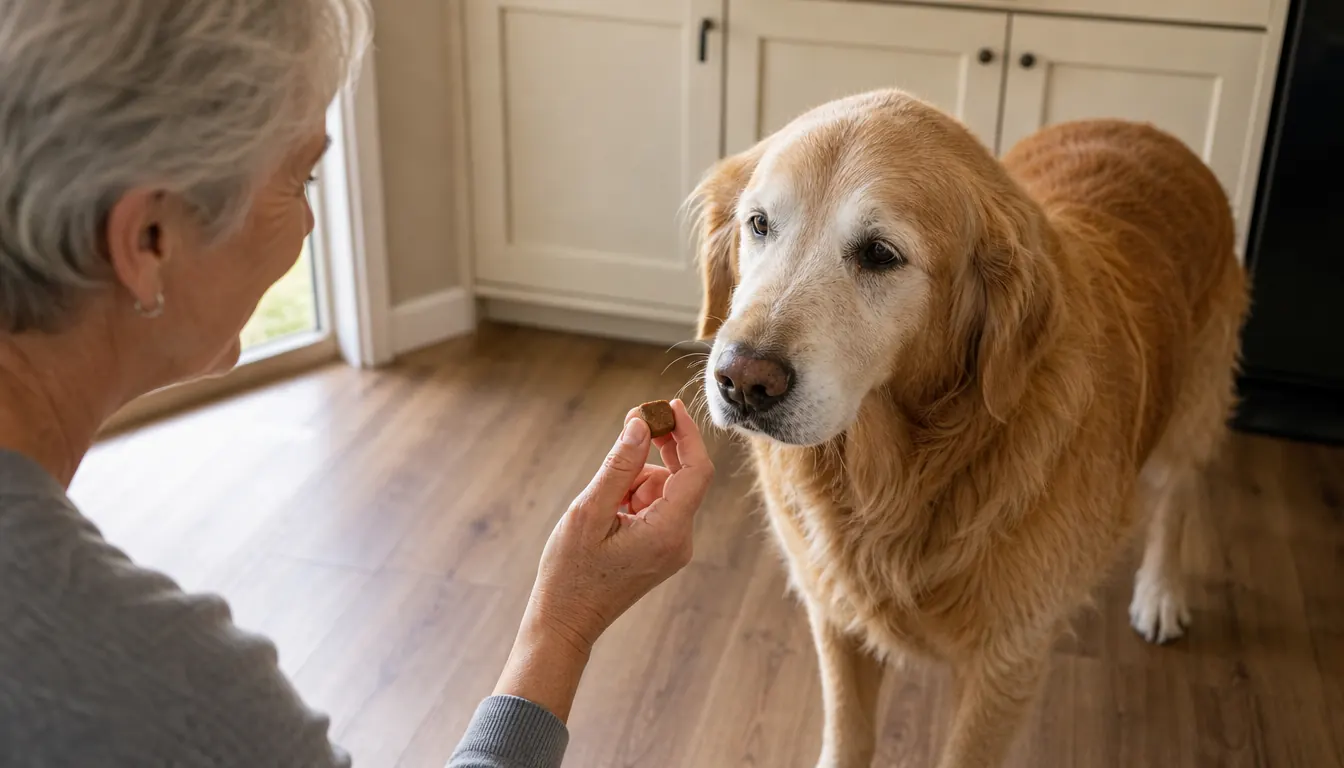
The chew Hazel gets after her evening walk
Zesty Paws Mussel Mobility Bites are soft chews made with New Zealand green lipped mussel. Ask your vet first, then check the serving size for your dog's weight on the listing.
Amazon Check Today's Price on Amazon →The Five Steps I Would Take Again
Step 1: Talk to your vet before you buy anything at all
I know you have heard this and I know it sounds like something a clinic prints on a fridge magnet. I am telling you anyway, because of what Dr. Patel asked me at that first visit. It was not about Hazel's hips. It was about what else she was taking. At that point the answer was nothing. Hazel had never had a supplement in her life. That made her simple. Eight months later I had three supplements in the rotation, and the conversation is longer now, and it is a better conversation for it.
Bring three things to that appointment. The name of every food, treat and supplement your dog is currently getting. The label, or a photo of the label, for each one. And a plain description of what you actually see at home. Not 'she seems stiff.' Something more like 'she takes two tries to get up off the kitchen floor in the morning, and she stops at the porch steps before she goes up.' That second version is something a vet can work with.
Then ask directly whether a mussel chew is fine alongside whatever else your dog takes, prescription medication included. Ask whether anything in a green lipped mussel product would be a problem for your particular dog. Ask what you should watch for that would mean stopping and calling. Write the answers down in the car before you drive home, because you will not remember them, and neither will I.
Step 2: Read what the mussel is and where it comes from
Green lipped mussel sounds like a garnish on a restaurant plate. What matters on the label is that it is a real ingredient carrying its own naturally occurring glucosamine and chondroitin, and that the source is named. The Zesty Paws listing says the mussels are cold processed and sourced from New Zealand, and that the mussel brings its glucosamine and chondroitin along with omega 3 fatty acids. The listed benefits on that product are antioxidant, joint health, muscle health and nutritional support, with hip and joint support as the stated use. It is a soft chew in chicken flavor, 90 to a tub, 7.9 ounces net weight, and the tub itself measures about 3.66 by 3.58 by 3.23 inches.
Here is what I do in the aisle now. I turn the package over and look for wording that tells me the ingredient comes from a named place and not from a mystery blend. I look at whether it is a soft chew I can hand over or a powder I have to disguise, because a dog who refuses the chew is a dog getting nothing. I look at the serving line for a dog in Hazel's weight range, and I look at how many servings are actually in the tub. That last part matters more than I expected, and I will come back to it.
What I do not do anymore is buy on the front of the package. The front is written by somebody whose job is to make you feel something. The back is written by somebody whose job is to stay out of trouble, and that is the part I trust. If the ingredient list is vague, or the mussel source is not named, or the servings per container make the chew cost more per day than I am willing to spend, I put it back on the shelf and I walk away.
Six months in, I cannot tell you which of the three things Hazel takes is doing the work. I can tell you she gets up off the kitchen floor in the morning without that long pause now, and she takes the mussel bite like it is the best thing that happens to her all day.
Step 3: Let the label set the serving, not me
This is the part where I am no help to you at all, on purpose. I will not tell you how many bites to give your dog. The serving is printed on the tub, it is set by weight, and your vet is the one who should bless it. Hazel is 64 pounds, and what she gets is what the label shows for her weight, confirmed with Dr. Patel before the first bite went into her mouth. That is the whole of my advice on dosing, and it is not going to get any longer.
What I can tell you is how serving size changes the arithmetic on a tub. Ninety bites does not go far at a big dog's serving. With Hazel I noticed the level dropping faster than I had planned for, and I started keeping the tub in the cabinet instead of on the counter so I would stop dipping into it out of habit. If you have a 75 or 80 pound dog, plan to reorder, or look for a larger count if there is one. The bites themselves are small, and Hazel does not chew them so much as inhale them.
That is also why I check the count and the net weight on the listing against what actually arrives at the door. A tub is 90 bites at 7.9 ounces. If what shows up does not match what the listing said, that is a return, not a lesson in patience.
Step 4: Pick a time of day and make it the same time
Hazel gets her mussel bite in the evening, after the short walk, and I do it that way for two reasons. The first is that it is the easiest moment in my day to remember. The second is that she has started expecting it, which means she is standing at the cabinet on her own four feet, waiting, instead of lying in the corner while I putter around the kitchen. I will take that.
Whatever time you choose, make it a time that already exists in your day. After the morning trip out to the yard. Before bed. After the last walk. Do not build a brand new routine around it, because in February, when it is dark and cold and raining sideways, you will not perform a new routine. You will perform the routine you already have.
Giving it as a treat rather than as a pill matters more than I expected. Hazel takes it from my hand the way she takes the corner of a plain pie crust, and there is no wrestling, no hiding it in peanut butter, no picking it up off the floor and trying again. If your dog is a spitter, ask yourself whether a soft chew is the right form for them before you buy 90 of them.
Step 5: Give it weeks, keep a note, and be honest in that note
The hardest part of this whole business is that you will want an answer in four days. You will not get one, and the wanting will make you see things that are not there. So I keep a note on the fridge door. Not a score, not a chart, just a line every few days: how she got up, whether she stopped at the porch steps, how the evening walk went, whether she took the back steps on the first try.
Six months in, here is what the note says about the mussel bites. She takes them like a cookie, and she has never once turned her nose up at one. Beyond that, I honestly cannot separate what the Zesty Paws bites are doing from what the Dasuquin and the fish oil are doing, because she has been on all three at the same time. I am not going to claim otherwise to make a tidier story. What I can say is that she is still slower than she was at seven, cold damp mornings are still her worst mornings, and she is doing better than she was on that September morning when I stood in the yard watching her think about a step.
Two things should send you to the phone instead of to the note. If your dog stops eating, or starts vomiting or has loose stool after you add something new, stop and call your vet. And if your dog gets worse rather than better, that is information for your vet, not a reason to buy a second tub and hope.
What Else Helps
The chew is one small piece of a week. On its own it does nothing about the two things that made Hazel's mornings hard in the first place, which are laminate floors and a house with steps off the back porch. So here is the rest of what I actually did, in the order I did it.
The floors came first. A runner rug down the hallway arrived before any supplement, because a dog who slips will stop walking, and a dog who stops walking gets stiffer. Later the non slip socks took over on the kitchen tile, and she wears them from breakfast to bedtime, indoors only, never out in the yard and never on a walk. The bed came after that. A memory foam bolster bed with an open front so she can walk straight on and bolsters on three sides so she has something to lean her back against. She slept in it the second night, and it sits in the corner of the living room now.
One more note on the supplement side, since it always comes up. A mussel chew is not the same job as a glucosamine chew, and neither of them is the same job as a fish oil. The oil gets pumped over Hazel's breakfast kibble and she licks the bowl clean; her coat looked glossier within a month or so, and I say that carefully, because the joint side of it is not something I can measure. Three supplements is where I stopped. I did not stack a fourth, and I would not, without a specific reason and Dr. Patel's blessing.
Then there are the things that cost nothing at all. Walking in the cool part of the morning instead of the heat of the afternoon. Letting her lie in the shade by the tomato beds while I weed, instead of coaxing her around the block a third time. Keeping her at a weight the vet is happy with, which for a Golden Retriever is a lifelong job and not a diet. And never letting her take those back steps at a run. None of it is exciting. All of it helps more than any single tub of chews.

What I Would Not Do Again
I bought the first tub before I read the serving size, which is why it went faster than I was ready for. Now I check the count against a large dog's serving before I order, every single time, and I keep the tub out of sight between servings.
I also spent two weeks reading reviews from people with young working dogs and drawing conclusions from them. Reviews tell you whether dogs will eat the thing and whether the seller shipped it properly. They do not tell you what will happen with a ten year old Golden Retriever who is already on three supplements. Only your vet and your own note can do that.
If I had to name the single most useful thing in this article, it is the fridge note. The label tells you what is in the tub. The note tells you what is happening in your house, and that is the thing you will actually be deciding on six weeks from now.
If your vet says yes, this is the tub I bought
Zesty Paws Mussel Mobility Bites, 90 soft chews with New Zealand green lipped mussel in chicken flavor. Ask Dr. Patel first. Then check the serving size for your dog's weight on the listing.
Amazon Check Today's Price on Amazon →